


Ostraca
In ancient Greece, the citizens voted to ostracism saw their names inscribed on small shards of pottery, a type of portentous objects that ensured the categorical passage from a state of being to one of non-being before the community, its rules and its accredited institutions.
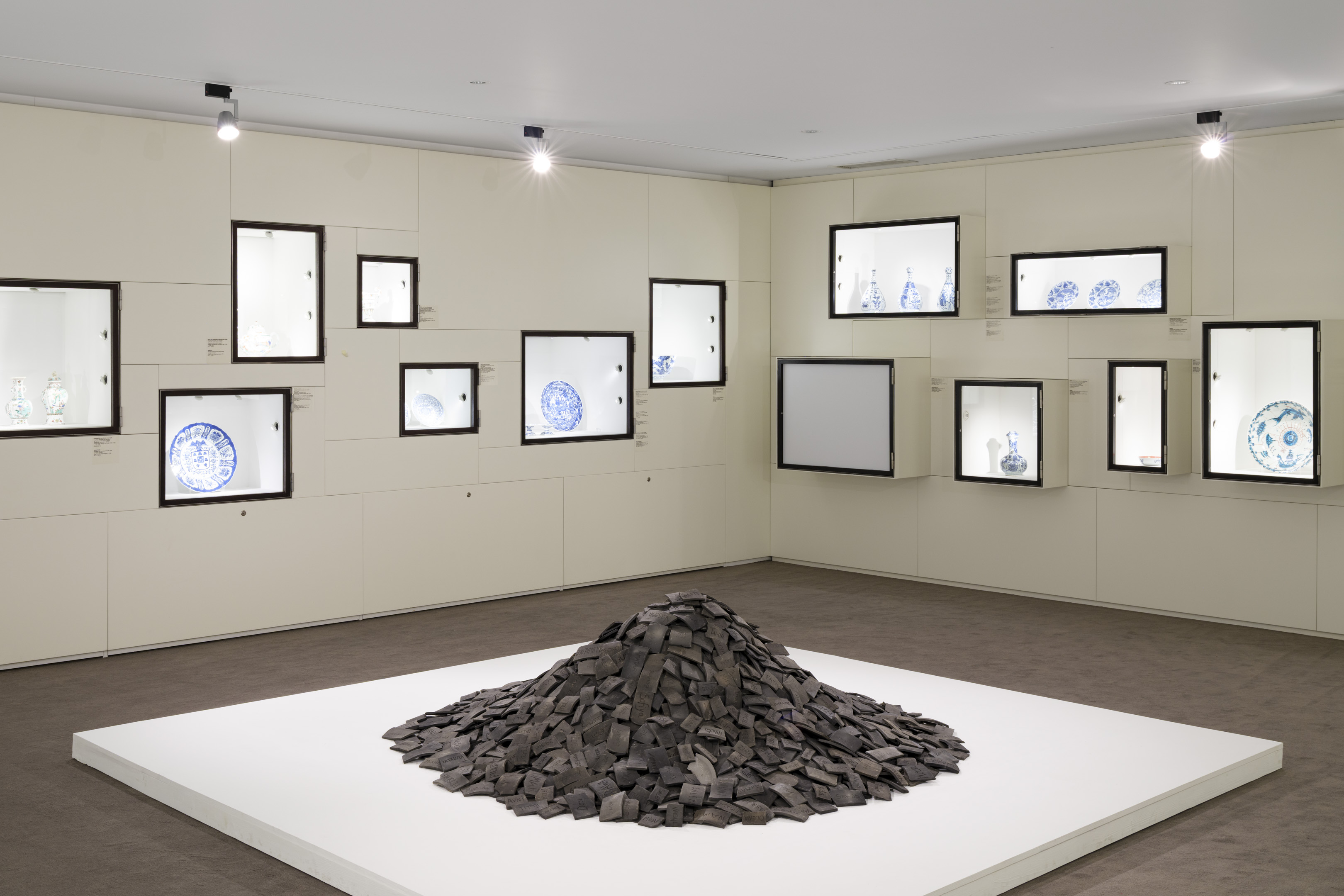
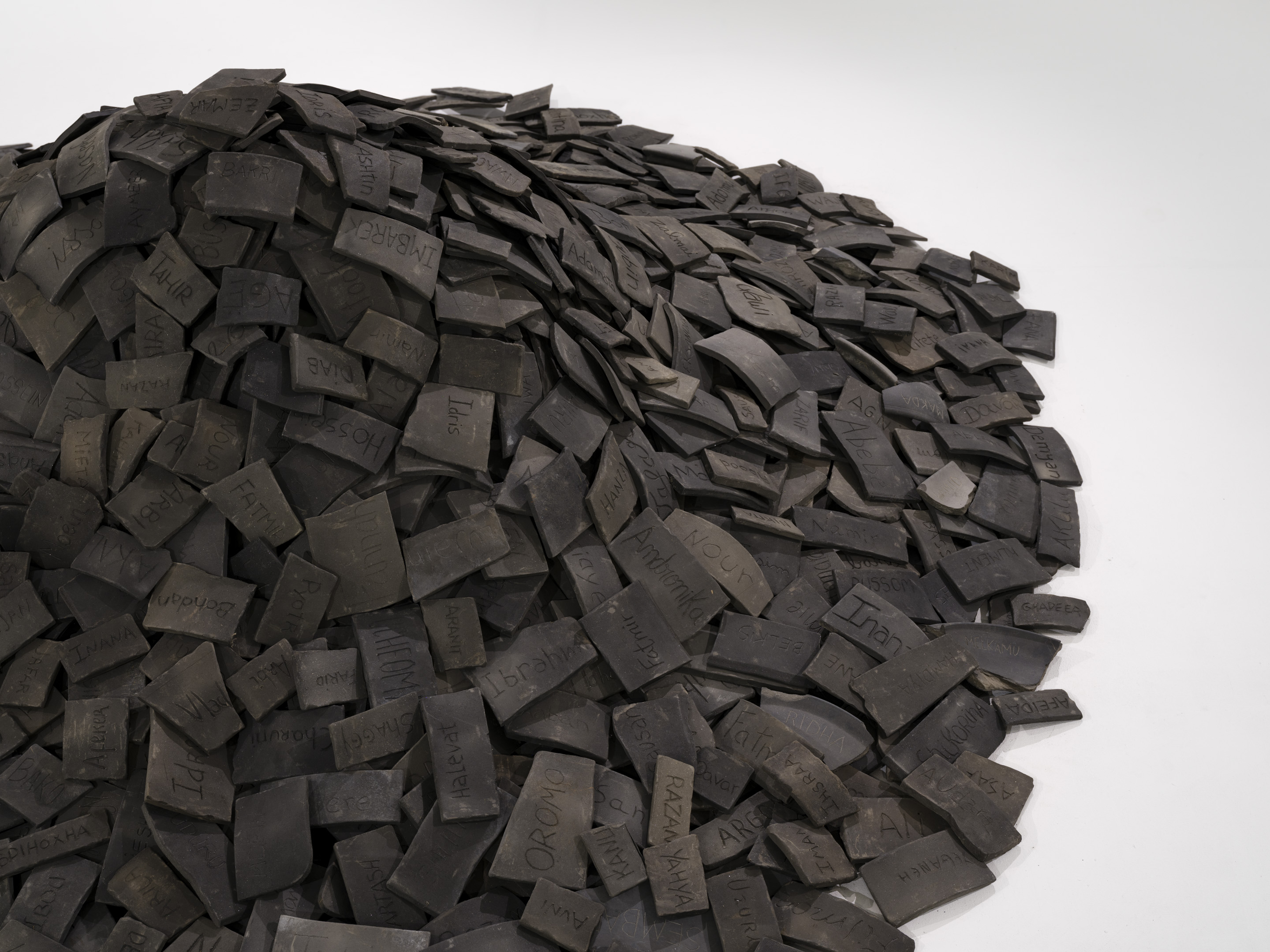
From those objects, and the acts of social organisation that gave rise to them, Carlos No created an artwork, and an exhibition, in the scope of an artist residency programme that took place in Tondela, Portugal. Taking advantage of the black clay of Molelos, the exhibition involved the participation of people from the municipality of Tondela through a workshop where the participants, which included the art students of the Tomás Ribeiro group of schools and the Senior University of the Tondela Rotary Club, were invited to create their own ostraca in pottery shards.
Carlos No's work has been reflecting on the concepts of border, margin, and exclusion, always according to a perspective of contextualisation in relation to contemporaneity and the socially dissimulated or violently explicit ways these concepts gain shape and body in the daily lives of different people. The concept of border implies division, a line that breaks and hinders or conditions exchanges, contacts, and movement, three forms of communication on which human nature is based. Margins only exist from an idea of centre, and it is not difficult to understand that the former are imagined as subordinate to the latter. Exclusion is the inevitable result of this conforming of the world to rigid concepts of a social ordering (and therefore also economic, political, sexual, cultural, etc.) one wants to maintain at all costs. Understanding who wants to maintain it and what mechanisms they resort to in order to achieve it is a significant part of how we can interpret the world.
Through a direct reference to Europe's historical and political past, this work intends thus to allude to a present-day situation that is very similar to the one mentioned above where, almost in the same way, we currently witness certain European political institutions vote on the number of people who should have access to the Schengen Area, and his country in particular.
There is thus no concealment of the allusion to a present-day situation related to the massive influx of migrants who every day seek to gain access to this geo-politico-economic space that is the European Union, where people who, in theory, “do not belong” to this territorial area are prevented from doing so in various ways yet for one reason alone: that of not being wanted amongst us “European citizens”, according to segregationist theories they themselves have invented.
Similarly to what took place in the ancient Greek polis, where the unwanted citizens were excluded from society and sent off into exile, it seems that, unfortunately, it is now the turn of a considerable proportion of Europe to seek to punish in the same way all the migrants who are not wanted here, and should thus be banished from this space/territory, when they are not, even before that, prevented from entering it.
Sara Figueiredo Costa
Lisbon, November 2015
Photos: Zétavares ©
---------------------------------------------------------
"ÓSTRACOS"
Carlos No brings to the Carmona e Costa Foundation an installation that deals with a number of issues
that have long been a subject of his work: the fragility of the human condition, exclusion, the margins and
imbalances caused by social dynamics, the vulnerability resulting from political choices or war. The
unique position ÓSTRACOS [OSTRAKA] holds in Carlos No’s oeuvre stems, therefore, not so much
from the expectations of meaning that the title conveys, but rather from the complexity imparted by the
material used and the production process devised by the artist.
ÓSTRACOS is composed of more than a thousand small fragments of clay inscribed with proper names,
through which the artist revives memories of a mechanism that, in Ancient Greece, was set in motion to
literally ostracise someone — i.e. to strip that person of their citizenship rights. Going beyond mere
historical evocation, ÓSTRACOS re-enacts, through its materials, the underlying gesture that legitimises
exclusion as it is experienced today. In other words, Carlos No’s installation exudes a complex symbolic
stratification, rich in meanings onto which our present is projected. The dynamic of exclusion that
historical evocation lends to the small ostraka is extensively explored, but also intensified, because the
artist has sought to heighten the tensions within his installation. For instance, the male and female proper
names on the clay pieces came from a list, compiled by the artist himself, of names commonly used in
countries across Africa, the Middle East and Asia that make up the bulk of immigrant communities in the
southern Mediterranean countries of Europe.
In addition to this past/present interplay, Carlos No introduces a further significant contrast in
ÓSTRACOS, which is based on the inclusive and participatory process through which he orchestrated the
creation of the clay fragments that make up the work. The piece was conceived during an artistic
residency in Tondela, where the artist was able not only to make use of local clay and traditional firing
techniques, but also to organise workshops involving the local community. Consequently, the fragments
are inscribed with a positive-affective value linked to the community that made them. The opposition to
the exclusionary dynamic associated with the evocation of history and the (often tragic) vulnerability of
contemporary immigration that this community-based process embodies possesses a structural quality.
Through it, the artist confronts us with the coldness of boundaries, the contingency of judgements and,
ultimately, the contradictions that have always been and continue to be part of the human condition.
At the same time, and as is always the case with Carlos No’s body of work, ÓSTRACOS is marked by a
very carefully crafted formal definition. In each new presentation, the installation renews the dialogue that
the artist has engaged in, from the very beginning, with the legacy of the minimalist sculptors.
Joana Cunha Leal
March 2026